
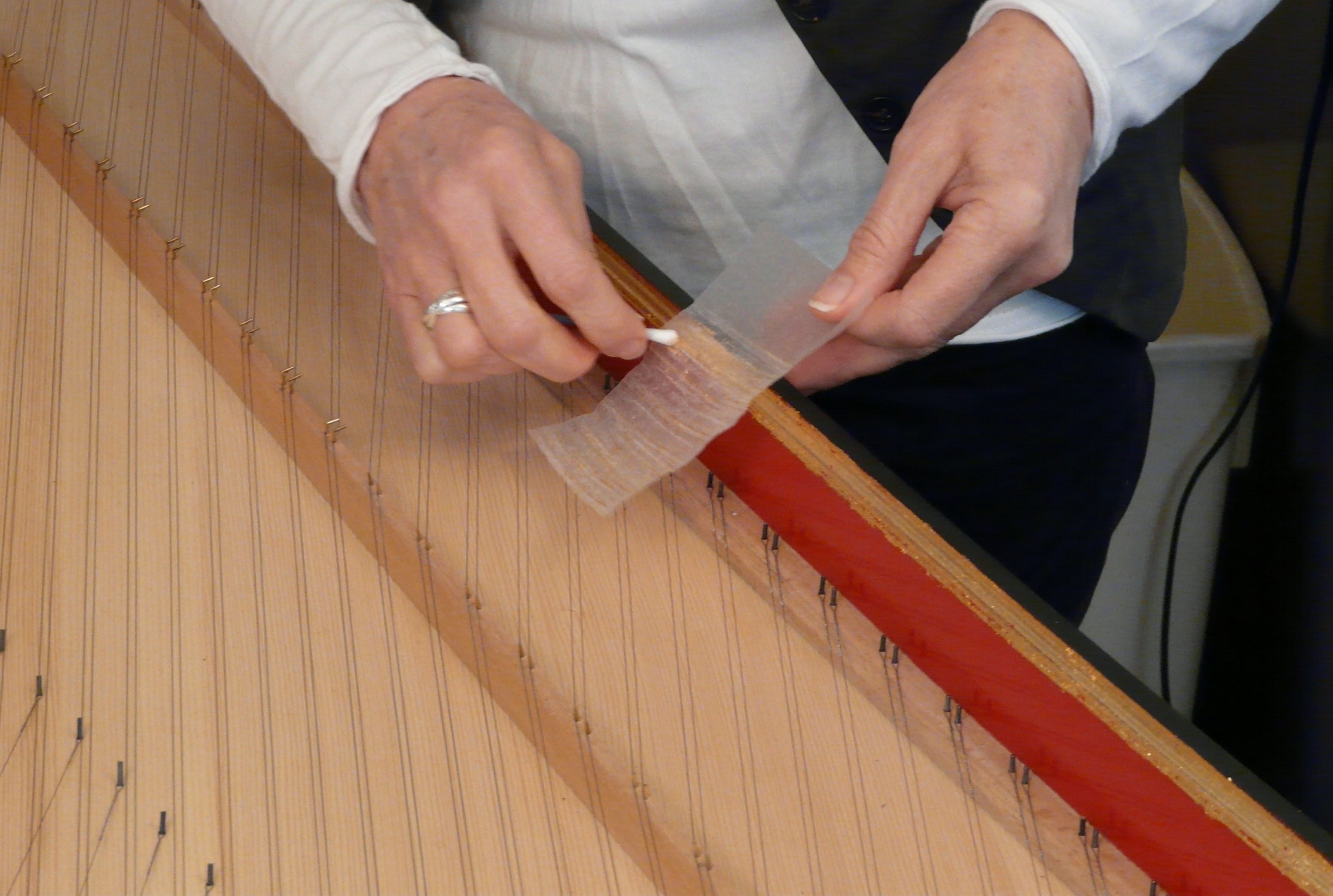
Lorraine applying gold leaf transfer to the mouldings
Just by her right hand, you can see the start of the "back-pinning" on the bridge; this helps to link the strings firmly to the bridge, and the tension also gives the soundboard some torsion in the direction of the spine, helping to maintain a slight 'crown' on the soundboard. You don't want the soundboard to sink downwards under the pressure of the strings running over the bridge, because any variation in the horizontality of the soundboard alters the gap between the top of the plectrum and the bottom of the string, which needs to be constant. Backpinning normally starts from the yellow brass strings downwards. These larger diameter strings are given more energy from plucking, and this would tend to dissipate in the non-speaking part of the string (from the bridge to the hitchpin rail) if the strings were not kept in firm contact with the bridge by means of back-pinning.